Now Reading: ✍️ How to Make Money on Fiverr (Complete Beginner to Pro Guide 2026)
-
01
✍️ How to Make Money on Fiverr (Complete Beginner to Pro Guide 2026)
✍️ How to Make Money on Fiverr (Complete Beginner to Pro Guide 2026)


How to Make Money on Fiverr (Complete Beginner to Pro Guide 2026) In 6 Steps.
Freelancing · Real experience
I Made $47 My First Month on Fiverr. Then I Figured Out What I Was Doing Wrong.
Three years, hundreds of orders, and one very embarrassing early profile later — here’s what nobody tells you before you sign up.
HR
Hana Rehman
Fiverr seller · Top Rated since 2024 · Based in Lahore · May 13, 2026
My first profile photo on Fiverr was a picture of my cat. I’m not kidding. I thought it made me seem approachable. I also wrote my gig description in third person — “Hana is a skilled writer with a passion for storytelling” — like I was submitting a press release about myself to a magazine nobody reads. I got two orders in my first month. One was from my cousin. The other cancelled.
That was 2021. I’ve since done over 400 orders, hit Top Rated seller, and had months where Fiverr alone paid my rent. But I want to be clear about something before we go any further: none of that happened because I found some secret hack. It happened because I eventually stopped treating the platform like a lottery and started treating it like a real business that needed actual work.
So let me tell you what Fiverr actually is, how it works, and — most importantly — how to get people to actually find and hire you.
What Fiverr is, without the marketing language
Fiverr is a marketplace where you sell a service and a stranger buys it. That’s genuinely all it is. You list what you can do, set a price, and when someone places an order, you do the work, they pay, Fiverr takes 20% off the top, and you get the rest.
The name comes from the original $5 starting price — back when the site launched in 2010, everything cost five bucks. That’s ancient history now. You’ll find gigs ranging from $5 to literally $10,000 on there, depending on what’s being sold and who’s selling it.
Services are organized into categories — writing, design, programming, video editing, voice-overs, marketing, music production, translation, legal consulting — and within each category there are hundreds of subcategories. If you have a skill that can be delivered digitally, there’s almost certainly a place for it on Fiverr.
The 20% commission is the thing that catches almost every new seller off guard. You charge $100, you receive $80. Price accordingly from day one — don’t set rates based on what you want to take home and then discover Fiverr’s cut later.
Buyers come from everywhere — the US, UK, Australia, Germany, Canada, and increasingly from smaller markets too. Most are small business owners, entrepreneurs, startup founders, marketing managers, or content creators who need something done but either can’t do it themselves or don’t want to spend agency money on it.
The buyers on Fiverr aren’t looking for the cheapest option. They’re looking for the safest bet. Your job is to look like the obvious, low-risk choice.
Getting traffic to your gig — and why most people think about this wrong
When people ask “how do I get traffic on Fiverr,” they usually mean: how do I get strangers to click on my gig? But that’s actually the second problem. The first problem is showing up in front of them at all.
Fiverr has its own internal search engine. When a buyer types “logo designer for restaurant” into the search bar, Fiverr’s algorithm decides which gigs to show them, in what order. That decision is based on a handful of factors — how well your gig matches the search query, how many orders you’ve completed, how fast you respond to messages, your cancellation rate, and your overall review score.
What this means in practice: your gig title and description are not just descriptions of your service. They’re your SEO. And most people write them like they’re describing themselves to a recruiter, not like they’re trying to rank for a search term a buyer is actually going to type.

How to actually write a gig that gets found
Open Fiverr. Don’t log in yet. Just go to the search bar and start typing your service. Watch what the autocomplete suggests. Those suggestions are pulled from real buyer searches — Fiverr is literally showing you what people type when they’re looking to hire someone like you.
“Logo design” might autocomplete to “logo design for restaurant,” “logo design minimalist,” “logo design with source file.” Those phrases — not your own invented description of what you do — are what belong in your gig title.
Then in your description, use variations of those terms naturally throughout. Don’t keyword-stuff. Write for the buyer first, the algorithm second. But make sure the words buyers search for are actually in your gig — because if they’re not, you simply don’t exist when they look.
The five traffic sources that actually work
Internal Fiverr search is the biggest and most important one. But there are others worth knowing about.
Fiverr search
Best long-term channel. Takes 4–8 weeks to get traction but compounds over time as reviews build.
Buyer requests
Hidden inside your seller dashboard. Buyers post what they need, you pitch them. Underused by 90% of sellers — use it especially when you’re new and have zero reviews.
Post a result you got for a client. Don’t pitch. Just share the work. Business owners will DM you. Link your Fiverr profile in your bio.
Works surprisingly well for visual services — design, video, social media. Create a pin with a before/after or portfolio image, link it to your gig.
Reddit / forums
Slow, but buyers from these sources are usually higher quality and more serious. Help first. Mention your gig only when it’s directly relevant.

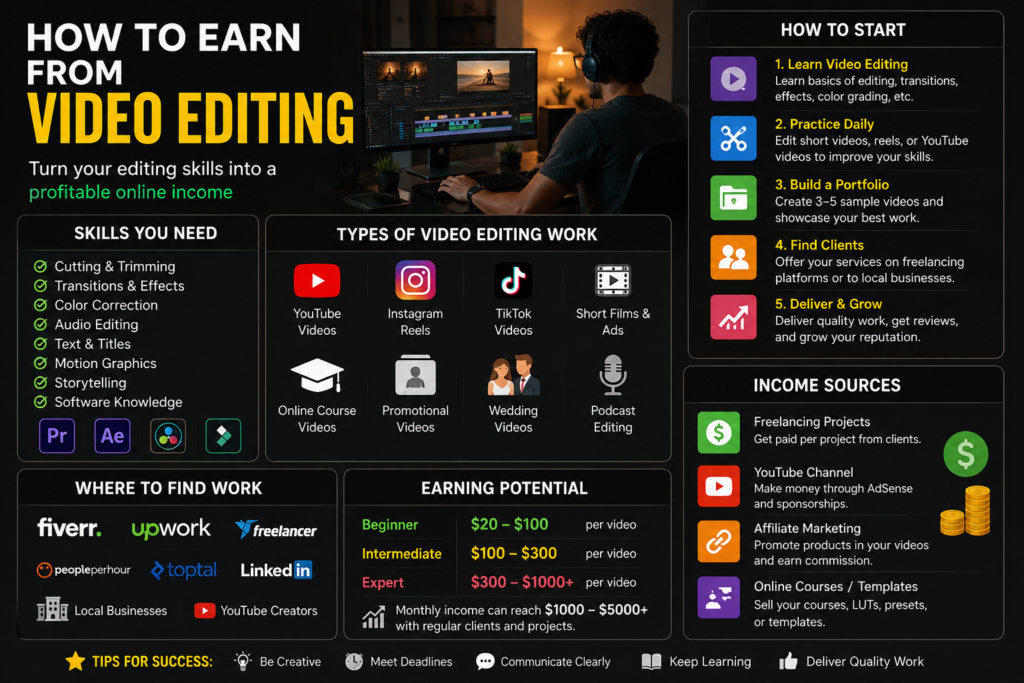
Most Fiverr sellers work exactly like this — from home, on a laptop, with no commute and flexible hours. The catch is you have to build the clients yourself.
What my earnings actually looked like, month by month
I get asked this a lot and I’m going to answer it honestly rather than giving you the highlight reel. These are my real numbers from my first year — a writing and content strategy gig:
Month 1–2
$47
Bad gig title, no reviews, no idea what I was doing
Month 3–4
$280
Rewrote profile, first real reviews starting to come in
Month 6
$740
Algorithm started showing my gig, repeat buyers appearing
Month 12
$2,100
Top Rated, three active gigs, regular client base
Month one to two was genuinely demoralizing. I almost closed the account twice. What kept me going was that the platform clearly worked — I could see other sellers in my niche earning properly. That meant the issue was me, not the platform. Which was annoying but also fixable.
The things I got wrong that cost me real money
I priced too low for too long. I thought staying cheap would mean more orders. What it actually meant was attracting buyers who expected unlimited revisions for nothing, complained constantly, and left mediocre reviews even when I overdelivered. When I raised my prices, my order quality improved immediately. Better buyers come in at higher price points.
I didn’t have package tiers for the first four months. Every gig was a flat price. The moment I added Basic / Standard / Premium packages, my average order value went up by about 40% — because most buyers chose the middle tier, which I’d priced to be the obvious best value.
I was terrible at scope creep. Someone would order a 500-word product description and then ask for three more “while you’re at it.” I’d do them because I was desperate for a good review. What I should have done — and eventually did — was write crystal-clear gig descriptions that spelled out exactly what’s included and what costs extra. You’re not being difficult. You’re being professional.
The single fastest thing I did to increase my Fiverr income wasn’t finding new buyers. It was getting better at keeping the ones I already had.
Once I had maybe 15 regular clients, I started treating follow-up like part of the job. After each delivery I’d ask if there was anything else on their list I could help with. Not in a pushy way — genuinely. About a third of the time they had something. That alone turned one-time orders into monthly recurring work, which is the closest thing to stability you’ll find on this platform.
One last thing before you sign up
Fiverr does work. It’s not a scam, it’s not saturated to the point of being useless, and you don’t need years of experience to start making real money on it. What you do need is patience past the first couple of months, a gig page that actually speaks to what buyers are searching for, and enough professionalism in your delivery that people feel good about coming back.
The cat profile photo is gone, by the way. Replaced it with an actual headshot in 2022. My impressions went up 60% in the following two weeks. Sometimes the fix is embarrassingly simple.